You have just finished scrubbing the kitchen sink, and the brush you used still looks brand new after three months of daily use. The one you bought last year fell apart after two weeks. The difference is not luck. It is a combination of bristle material, handle ergonomics, and how well the brush matches the surface you are cleaning.
For most homeowners, the phrase "best cleaning brush" means something different depending on whether they are scraping burnt food off a cast iron pan, whitening grout lines in the bathroom, or sweeping fine dust from the corners of a hardwood floor. A stiff nylon brush that removes baked-on grease will scratch a glass cooktop. A soft foam brush that is gentle on delicate ceramic will not move mildew from a shower grout line.
This guide gives you a practical framework for choosing the right brush for each cleaning job, based on the same criteria that professional cleaning suppliers and procurement teams use when they evaluate tool performance. If you are buying for your own home, this will help you avoid making costly mistakes. If you are a retailer or brand owner sourcing brushes for your own product line, this guide also explains the engineering decisions behind brush design that affect performance, durability, and customer satisfaction.
We have spent more than three decades manufacturing cleaning tools for retail chains and brand owners across 65 countries. In that time, we have observed a consistent pattern: people who understand brush materials and construction make smarter buying decisions, whether they are purchasing one brush for their bathroom or fifty thousand for a national retail rollout. The rest end up with bins full of broken, moldy, or ineffective brushes.
The honest conclusion is this: the best brush for your house is not a single product. It is a small set of three or four specialized brushes, each chosen for a specific surface and soil type. Professional cleaners do not carry one all-purpose brush. They carry a kitchen brush, a bathroom brush, a floor scrub brush, and a dust brush. Each has a different bristle density, handle length, and working angle because each is engineered for a different job.
What Makes a Cleaning Brush "Best"? Five Criteria That Actually Matter
When cleaning professionals and retail buyers evaluate brushes, they look at five measurable criteria. If a brush fails on just one of these, it will disappoint the user, no matter how good it looks on the shelf.
1. Bristle Stiffness and Material
The bristle material is the single most important factor. It determines whether the brush scrubs, polishes, or simply smears dirt around. The three dominant synthetic materials are nylon, polypropylene (PP), and polyethylene terephthalate (PET). Nylon is the most abrasion-resistant and springy, which makes it ideal for removing baked-on food. Polypropylene is stiffer and more economical, often used for bathroom and floor brushes. PET is generally the most cost-effective and is commonly used for dusting and light scrubbing.
Within these materials, the physical properties vary with the filament diameter. A 0.30 millimeter nylon filament feels noticeably different from a 0.25 millimeter filament. When a manufacturer specifies filament diameter and density for each brush model, that decision determines whether the brush can remove heavy soil or just glide over it.
2. Surface Contact
A brush with a flat, uniform bristle face cleans better than one with an uneven face because it applies pressure evenly. During injection molding, the bristle tuft design and the density of the filament bundles control how well the brush face contacts the surface. On complex shapes, like a toilet bowl curve, the bristle face needs to be contoured to meet the surface at the correct angle. On flat surfaces, like a floor, the bristle face should be perfectly planar.
Commercially, we measure this by testing how much pressure is needed to deform the bristle face across different areas of the brush. If the pressure varies by more than 15 percent across the face, the brush will leave streaks and will not clean consistently.
3. Handle Ergonomics
A comfortable grip matters more than most people realize, especially for tasks that take more than ten minutes. The handle length, diameter, and texture all affect user fatigue. A brush that hurts your wrist after two minutes is not a good brush, no matter how powerful the bristles are. In our product design process, we test handle prototypes with a panel of users who clean on a regular basis. Their feedback on grip comfort, weight distribution, and wrist angle determines which prototype enters production. This is a manufacturing discipline that many low-cost brush suppliers skip entirely.
4. Durability
A good brush should survive hundreds of uses without shedding bristles or cracking. In factory quality testing, we run brushes through repeated scrubbing cycles on simulated rough surfaces. A brush that sheds bristles or loses its shape after 50 cycles fails the test. A well-made brush should maintain its original bristle face for at least 200 to 300 scrubbing cycles.
Durability is not just about the bristles. The handle base is where the bristle tufts are anchored. If the handle is made from thin, brittle plastic, the tufts will pull out after moderate use. The anchor technique used during manufacturing is what keeps bristles in place under repeated stress.
5. Hygiene
Brushes used in kitchens and bathrooms need to be easy to rinse and dry, or they become breeding grounds for bacteria. A brush with dense, tightly packed bristles traps water and food particles. A brush with well-spaced tufts allows water to drain and air to circulate. The handle should not have crevices where grime collects unnoticed. Some brush designs include drainage holes in the handle or a hanger loop that allows the brush to hang upside down. These design details may seem minor, but they significantly affect how long the brush stays fresh.
Here is the takeaway: the best brush is the one that is designed for the specific job you are doing. The following sections break down the five main categories of cleaning brushes and explain what to look for in each.
The Five Main Types of Cleaning Brushes for House Cleaning
Every cleaning brush falls into one of five functional categories. Understanding what each category is designed to do will help you narrow your search immediately.
Kitchen Brushes
Kitchen brushes are designed to handle grease, burnt food, and stuck-on residue. They are used on dishes, pots, pans, cutting boards, and sink fixtures. The typical kitchen brush has medium-stiff bristles, a compact head for reaching into narrow openings, and a handle long enough to keep your hands out of hot washing water.
The most common variants include dish brushes with an integrated soap reservoir, bottle brushes with a long narrow neck, and pot scrubbers with a short, wide face. A dish brush with a soap reservoir is convenient for everyday dish washing, but the reservoir must be properly sealed to prevent leakage. A bottle brush is essential for water bottles, wine glasses, and jars. A pot scrubber with a short handle gives you the power to remove burnt food without soaking your hand in hot water.
In our manufacturing experience, kitchen brushes are the highest-volume category in home cleaning. They are also the category with the highest return rate when quality is poor. If a brush sheds bristles while someone is washing dishes, the customer loses confidence in the brand immediately.
Bathroom and Toilet Brushes
Bathroom brushes are engineered for mineral buildup, soap scum, and biological soils. Toilet brushes need a narrow, contoured head that can reach the inside of a toilet bowl, including the under-rim area. Tile and grout brushes need stiff, pointed bristles that can dig into narrow grout lines. Bathroom brushes must also resist moisture damage because they are constantly wet, so the handle and bristle anchors need to be well sealed.
A common design problem in toilet brushes is the drip guard. Without a drip guard, dirty water runs down the handle and leaves a puddle inside the holder. With a properly designed drip guard, the brush head stays cleaner and the holder stays dry.
Floor Scrub Brushes
Floor scrub brushes are used to clean hard surfaces such as concrete, tile, stone, and wood decking. They have a wide, flat bristle face and a long handle or a push-broom style frame. The key difference between a floor brush and a broom is the bristle density: a broom sweeps loose dirt, while a floor brush scrubs bonded dirt, grease, and stains off the surface.
For commercial cleaning, floor scrub brushes are used in combination with a cleaning solution and a bucket. In home use, they are often used on bathroom floors, patios, garage floors, and entryways. If you live in a region with muddy shoes or pet companions, a floor scrub brush near the entryway can reduce the amount of dirt tracked into the house.
Dust Brushes
Dust brushes are lightweight tools with soft, fine bristles designed to capture loose dust and debris without scratching delicate surfaces. They are commonly used along baseboards, in corners, on window sills, and on furniture. A dust brush may also have replaceable brush heads, which extends its useful life and reduces waste.
A good dust brush has a comfortable grip and a head size that fits into tight spaces. The bristles should be soft enough that you can run the brush over a piano or a picture frame without leaving scratches, but dense enough that it actually picks up dust rather than pushing it around.
Specialty Brushes
Specialty brushes fill the gaps that general-purpose brushes leave behind. Examples include bottle brushes for narrow-mouth containers, bead-and-grout brushes for detail work, crevice brushes for window tracks, radiator brushes for deep ventilation slots, and angled brushes for shower doors or specific appliance surfaces. When a cleaning job is unusually messy or the surface is hard to reach, a specialty brush is worth the extra expense.
If you already know which category fits your main cleaning challenge, skip ahead to the relevant section. If you are building a complete cleaning toolkit, we recommend one brush from each category. The investment is modest, and the performance gain is significant.
Bristle Materials Explained: How to Choose the Right Stiffness
Bristle material is where most consumers get confused, because the differences are not obvious at a glance. Here is a clear comparison based on the materials most commonly used in cleaning brushes.
Comparison of common bristle materials used in household cleaning brushes
| Material |
Stiffness |
Abrasion Resistance |
Best Use |
Durability |
| Nylon |
Medium to high |
Excellent |
Kitchen scrubbing, grout, baked-on food |
Very high |
| Polypropylene (PP) |
High |
Good |
Bathroom, floor scrubbing, outdoor cleaning |
High |
| PET |
Low to medium |
Moderate |
Dusting, light kitchen cleaning, dish washing |
Moderate |
| Natural fibers |
Low to medium |
Low |
Gentle polishing, delicate surfaces |
Low |
Nylon is the premium choice for heavy scrubbing. It has a springy return after being compressed, which means the bristle face maintains its shape after each stroke. This is why kitchen brushes made with nylon filaments tend to outlast cheaper alternatives. However, nylon is more expensive to produce, so it is usually found on higher-end brushes. In a retail setting, you will see nylon brushes priced higher than PET or polypropylene equivalents, and the difference in longevity usually justifies the premium.
Polypropylene is the workhorse of the cleaning industry. It is stiff, inexpensive, and resistant to most household cleaning chemicals, including bleach and dilute acids. If you need an aggressive brush for bathroom tile, outdoor stone paving, or a barbecue grate, polypropylene is the practical choice. The stiffness of PP also makes it excellent for brushes that need to maintain their shape when soaked in hot water, as it does not soften as much as nylon.
PET is the most common material in low-cost brushes. It is soft, lightweight, and holds dye well, which is why most colorful dust brushes are made from PET. It is adequate for dusting and light dish washing, but it will flatten out quickly on rough surfaces. For a brush that will be used once a week for dusting, PET is a reasonable economy. For a brush that will be used daily for scrubbing, PET is a compromise you will eventually regret.
Natural fibers such as tampico and palmyra are used in very specific applications, like brushing vegetables or cleaning fine wood surfaces. They are gentle but not durable, and they absorb water, making them prone to bacterial growth if not dried properly. Their main advantage is that they are biodegradable, which appeals to eco-conscious consumers, but their performance limitations make them a niche choice.
In manufacturing, one additional factor determines bristle performance: the way bristles are anchored. In our factory, we use a technical process called bristle tufting, where bundles of filaments are folded, anchored, and embedded in the handle base. The pull-out force of each tuft is tested during production to prevent bristles from shedding after repeated use. A brush with 30 percent more bristle density will also last longer and clean faster because it applies more scrubbing points per square centimeter.
Ergonomics: Which Handle Design Actually Reduces Fatigue?
After bristle material, handle ergonomics is the second most important criterion. In professional settings, workers who clean for hours at a time choose brushes that minimize wrist strain, even if the brush cost is higher. The same logic applies to homeowners who clean for twenty minutes at a stretch. A brush that is uncomfortable to hold will make you less likely to clean, which defeats the purpose of owning it.
The three factors that matter most are handle length, handle diameter, and working angle.
- Handle length. Short handles are best for surface scrubbing where you need precise control, such as wiping a sink or cleaning a stovetop. Long handles are best for floor scrubbing, where you need to protect your back. A brush with a 20 to 30 centimeter handle is comfortable for sink and counter work. A floor brush should have a handle of at least 1 meter. For a toilet brush, a handle of 35 to 45 centimeters is standard because it provides enough reach without making the brush difficult to store.
- Handle diameter. A grip that is too thin forces your fingers to work harder. A grip that is too thick reduces your power transfer. Most comfortable handles are between 2.5 and 3.5 centimeters in diameter, with a textured or rubberized surface for non-slip control. In wet conditions, a textured handle is essential. In our ergonomic testing, we found that a diameter of 3.0 centimeters with a soft-touch rubber overlay is the most comfortable for most users.
- Working angle. A 45-degree angle between the bristle face and the handle is the most efficient for scrubbing horizontal surfaces. It allows you to apply downward force without bending your wrist. Some brush designs feature a pivoting head that adjusts to the surface, which is especially useful for bathroom tile and shower doors. A pivoting head can add a small degree of play, which reduces force transmission, so the pivot joint needs to be well-engineered.
Weight is also a factor. A brush that feels too heavy causes fatigue, but a brush that is too light often has poor balance. The center of gravity should sit roughly one-third of the way down from the grip point to the bristle face. When a brush is balanced properly, you feel less effort with every stroke. In our production process, we measure the weight distribution of every handle mold to ensure the brush feels natural in the hand.
Choosing the Right Kitchen Brush: What Most Shoppers Overlook
The kitchen is the most demanding environment in the house for cleaning brushes. Between grease, burnt-on food particles, and constant exposure to hot water, a kitchen brush works hard every day.
For washing dishes, a brush with medium-stiff bristles is the sweet spot. Bristles that are too soft leave grease smears on plates. Bristles that are too hard can scratch non-stick pan coatings. The right bristle material for this job is nylon, because it combines scrubbing power with enough flexibility to work around curved surfaces.
For cleaning bottles and jars, a long-handled bottle brush is essential. The neck needs to be long and flexible enough to reach the bottom of a standard drinking bottle, while the bristle head needs to be wide enough to scrub the sides. A common error is buying a bottle brush with a head that is too short, which cannot clean the full depth of the container. If you primarily clean wide-mouth jars, a shorter head is fine, but for standard water bottles and wine glasses, you need a brush that is at least 20 centimeters long from the bristle head to the grip.
The bottle brush set with a storage holder from our product range is one example of a kitchen brush designed with these details in mind. The set includes multiple brush heads for different bottle sizes, and the storage holder allows the brushes to air dry, preventing mildew between uses. A brush that is stored in a closed drawer while still wet will develop mold in a hurry.
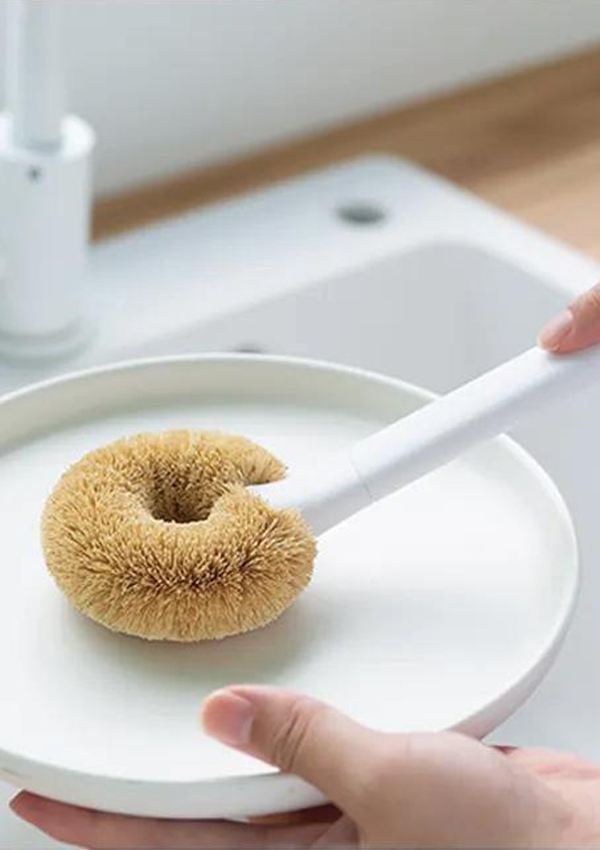 Versatile Bottle Brush Set with Storage Holder for Kitchen CleaningThis set includes multiple brush types—steel wool, coconut coir, PET, wire, wood fiber, and cup brush—plus a storage base that allows air drying to prevent mildew between uses.View Product →
Some kitchen brushes come with an integrated soap dispenser button. These are convenient, but the soap reservoir must be designed with a one-way valve, or the soap will leak out continuously. In manufacturing, we test the soap reservoir for leak resistance by filling it completely and holding it upside down for 24 hours. Brushes that fail this test are rejected during quality control.
When you choose a kitchen brush, check the bristle density at the edges. The edge tufts are what clean the rim of a pan or the seam of a cutting board. If the edge tufts are sparse, you will spend extra time on these difficult areas. Also, consider the brush head size. A larger brush head cleans more surface area per stroke, but it may not fit into narrow containers. A two-headed brush set, or a brush with a pivoting head, offers the best flexibility.
Bathroom and Toilet Brushes: What Separates a Good One from a Bad One
Toilet brushes and bathroom scrub brushes face a different set of challenges than kitchen brushes. They are used on hard, often textured surfaces, and they are exposed to moisture for most of their working life.
A good toilet brush needs three features. First, the head must have a tapered or contoured shape that allows it to fit inside the bowl. A flat round head cannot reach the under-rim area where stains build up. Second, the bristles must be stiff enough to remove mineral deposits, but not so stiff that they scratch porcelain. Polypropylene is the recommended material because it is hard-wearing and resists the chemicals in toilet cleaning products. Third, the handle needs a drip guard, which is a small flange above the bristle head that prevents dirty water from running down the handle.
Regular toilet brushes have one major weakness: they remain wet after use, and a wet brush sitting in a holder is a breeding ground for bacteria. Some newer designs address this by using replaceable, dissolvable brush heads that are flushed away after each use. These systems eliminate the need to store a dirty brush head in the bathroom. The innovative dissolvable toilet brush with automatic dispensing is an example of this approach. The handle holds a cartridge of cleaning solution, and each disposable brush head dissolves in the toilet after use. For high-traffic bathrooms or households with sanitation concerns, this design offers a meaningful advantage.
 Dissolvable Toilet Brush with Automatic Dispensing for Hygienic CleaningIts handle dispenses a disposable brush head saturated with cleaning agents that eliminate bacteria and dissolve in water, offering a hygienic solution for busy households.View Product →
For shower and tile cleaning, a brush with a smaller head and angled handle is more useful than a large stiff brush. You need to reach the corners of the shower, the grout lines, and the hinged edge of a shower door. A brush with an extended handle, sometimes called a bath scrub brush, is a more efficient choice than a hand-held scrubbing pad. The extra length lets you clean the upper walls of the shower without climbing into the tub.
In the bathroom, one additional consideration is ventilation. A brush with holes in the grip allows water to drain out instead of pooling inside. This reduces odors and prevents rust on metal components. If the handle is made from plastic, the drain holes also prevent condensation from becoming trapped inside the handle, where it can eventually weaken the bristle anchoring.
Floor and Surface Scrubbing Brushes for Hard Floors
Floor scrubbing is the category where most people underestimate the importance of brush design. A mop may remove loose dirt, but a floor scrub brush is what removes bonded dirt, scuff marks, and stains from hard surfaces such as tile, concrete, and stone.
The main difference between a broom and a floor scrub brush is the bristle density and angle. A broom has long, flexible bristles that sweep loose particles. A floor scrub brush has short, dense bristles that compress against the surface and agitate the dirt film. In industrial settings, floor scrubbing brushes are used with a rigid frame and are often pushed in a forward and back motion to generate enough friction.
When selecting a floor scrub brush for home use, look for a model with an interchangeable head. This feature allows you to replace the brush head rather than throw away the whole tool when the bristles eventually wear down. It is more cost-effective and more environmentally responsible. The dissoluble floor scrub brush with interchangeable brush heads is designed exactly for this use case. The brush heads can be swapped out, so you can use a stiff polypropylene head for outdoor stone and a softer nylon head for indoor tile without owning two separate tools.
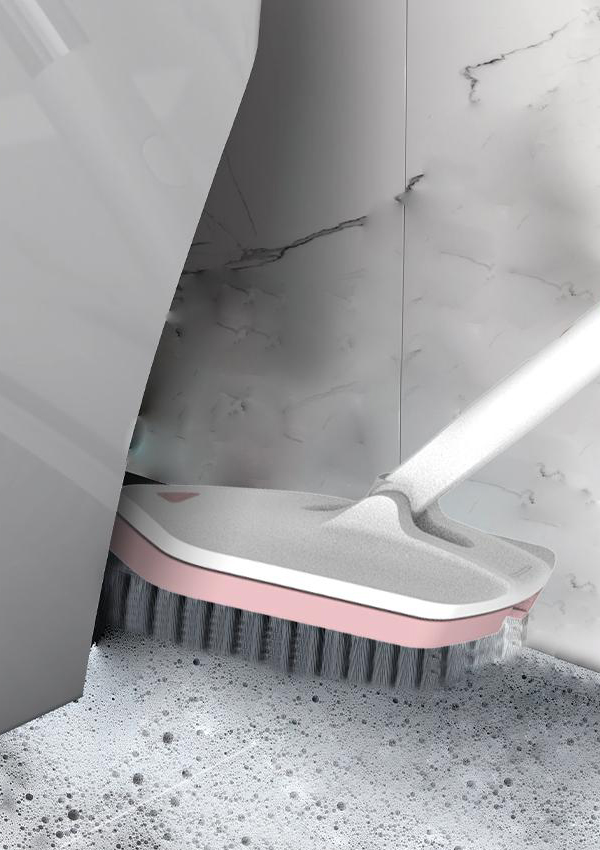 Floor Scrub Brush with Interchangeable Heads for Adaptable CleaningWith swappable brush heads of varying stiffness, this tool adapts to different floor surfaces—stiff for outdoor stone, soft for indoor tile—without needing multiple brushes.View Product →
The bristle stiffness for floor brushes should be matched to the surface. For rough concrete or outdoor stone, polypropylene is the right choice because it is stiff enough to dig into pores and remove embedded grime. For painted wood or delicate tile, a softer nylon brush is safer and will avoid scratching the finish. If you are unsure about the surface, start with a medium-stiff brush. You can always exert more pressure to increase cleaning power, but you cannot undo a scratch.
One practical detail that many shoppers overlook is the handle attachment. A floor brush with a screw-in or push-in handle should have a tight fit with no wobble. A loose handle will transfer less energy to the bristles and make scrubbing much harder. In our factory, we test joint stability by applying a side load to the handle and checking that the brush frame does not deflect more than a few millimeters.
Matching Brushes to Specific Cleaning Scenarios
If you are building a cleaning toolkit, the following table gives you a fast reference guide based on the most common household cleaning scenarios.
Recommended brush type and bristle stiffness for common household cleaning scenarios
| Cleaning Scenario |
Best Brush Category |
Recommended Bristle Material |
What to Avoid |
| Burnt food on cookware |
Kitchen scrub brush |
Nylon, stiff |
Metal scouring pads on non-stick surfaces |
| Greasy cutting board |
Dish brush with soap reservoir |
Nylon, medium |
Very soft brushes that only smear grease |
| Toilet bowl biofilm and stains |
Toilet brush, contoured head |
Polypropylene, stiff |
Brushes with flat heads that cannot reach under the rim |
| Grout whitening in the shower |
Tile and grout brush |
Nylon, pointed tufts |
Large brush heads that cannot enter narrow grout lines |
| Hard floor scuff marks |
Floor scrub brush with long handle |
Polypropylene, medium |
Mops alone, which may not remove bonded dirt |
| Baseboards and window sills |
Dust brush with soft bristles |
PET, soft |
Stiff brushes that can scratch painted surfaces |
| Narrow-mouth bottles and jars |
Bottle brush |
Nylon, medium |
Short brushes that cannot reach the bottle bottom |
This table is not a rigid rule. It is a starting point. The exact brush you choose will also depend on the size of your hands, the height of your countertops, and the specific habits you already have for cleaning.
How to Maintain and Extend the Life of Your Cleaning Brushes
Even the best brush will perform poorly if it is not maintained. Three simple practices will double the life of your brushes.
First, rinse thoroughly after every use. Food particles and cleaning solution residues can break down bristle material over time. The bristle base, the part where the filaments meet the handle, is the most vulnerable area. A quick rinse under running water and a gentle tap against the sink edge will remove most debris.
Second, allow your brushes to dry completely. Moisture trapped inside the bristle tufts creates the ideal environment for bacteria and mildew. A brush that stays damp for days will develop a distinct odor and will shed bristles faster. Use a wall-mounted holder, a suction-cup holder, or a ventilated storage basket. Brush storage that keeps the bristle head off the counter is essential.
Third, inspect bristle loss regularly. If you notice more than a few bristles falling out during a single cleaning session, the brush is no longer performing properly. Loose bristles can end up on dishes, in food, or on the floor. In commercial cleaning operations, brushes are typically replaced every three to six months, depending on usage. For home use, the same interval applies if you clean multiple times per week.
When the bristles wear down to half their original length, the brush has lost its scrubbing power. Even if the handle still looks new, the brush face no longer reaches the surface. At this point, replacing the brush is a better investment than continuing to scrub with a worn-out tool.
What Wholesale and OEM Buyers Should Look for in a Cleaning Brush Supplier
If you are a retailer or brand owner sourcing cleaning brushes, the selection process goes beyond the physical product. Your supplier's manufacturing capability affects how well the end customer will receive the product.
First, examine the bristle tufting quality. The way bristles are anchored is a direct indicator of manufacturing quality. In our own factory, over 35 injection molding machines run cleaning tool components, and each batch undergoes pull-out and wear testing. A supplier should be able to share quality control protocols before you sign a purchase order.
Second, consider mold technology. The geometry of the bristle tuft pattern, the angle of the handle, and the integration of a soap reservoir or a drip guard all depend on well-designed injection molds. A supplier with in-house mold design and 280-plus patented tool designs can usually offer more product variations, including custom solutions for your market. If you are launching a private-label brush, you want a factory that can design a mold from scratch, not just stamp out copies of an existing product.
Third, verify production capacity and consistency. A factory with 3,000 to 5,000 square meters of production space and a workforce of 200 to 300 people can handle large volume orders. More importantly, they can maintain batch-to-batch consistency, which matters for retail buyers who expect identical products in every customer order. Ask to see a sample from a previous production run and compare it against a current sample to check consistency.
Fourth, consider whether the supplier supports both OEM and ODM. OEM allows you to brand an existing product. ODM lets the supplier develop a new design based on your specifications. If your market has unique soil types, climates, or consumer preferences, ODM gives you flexibility that a pure OEM supplier cannot match.
Finally, check the factory's certification and audit records. A supplier that welcomes factory visits and can show you its quality control process is more likely to deliver reliable products than one that is evasive about production details.
Final Recommendations: The Right Brush for Every Job
To summarize, the best cleaning brush for your house is not a single product. It is a small, well-chosen set of specialized brushes:
- For the kitchen, choose a nylon-bristle dish brush and a bottle brush set with a storage holder. This combination handles dishes, cutting boards, and narrow containers without scratching or smearing.
- For the bathroom, choose a contoured toilet brush with polypropylene bristles and a drip guard. If you prefer a more hygienic solution, consider a disposable brush-head system with dissolvable heads.
- For hard floors, choose a floor scrub brush with an interchangeable head and the bristle stiffness matched to your floor type.
- For dusting and detail work, choose a soft PET dust brush for baseboards, window sills, and delicate surfaces.
Before you buy, review the five criteria: bristle material, surface contact, ergonomics, durability, and hygiene. A brush that looks good on the shelf but fails on these criteria will end up in the trash within a month. A brush that passes them will serve you well for years.
Whether you are buying one brush for your home or thousands for a retail line, the principles are the same. Start with the cleaning scenario, select the bristle material that matches the soil type, ensure the handle is comfortable for the amount of time you clean, and verify the brush has been manufactured to high standards.
To explore the different types of cleaning brushes used across the home, our industry article covers the full spectrum of brush categories in more detail. And if you are preparing for a broader cleaning project, our complete guide to cleaning tools provides a comprehensive overview of the entire toolkit you might need.